
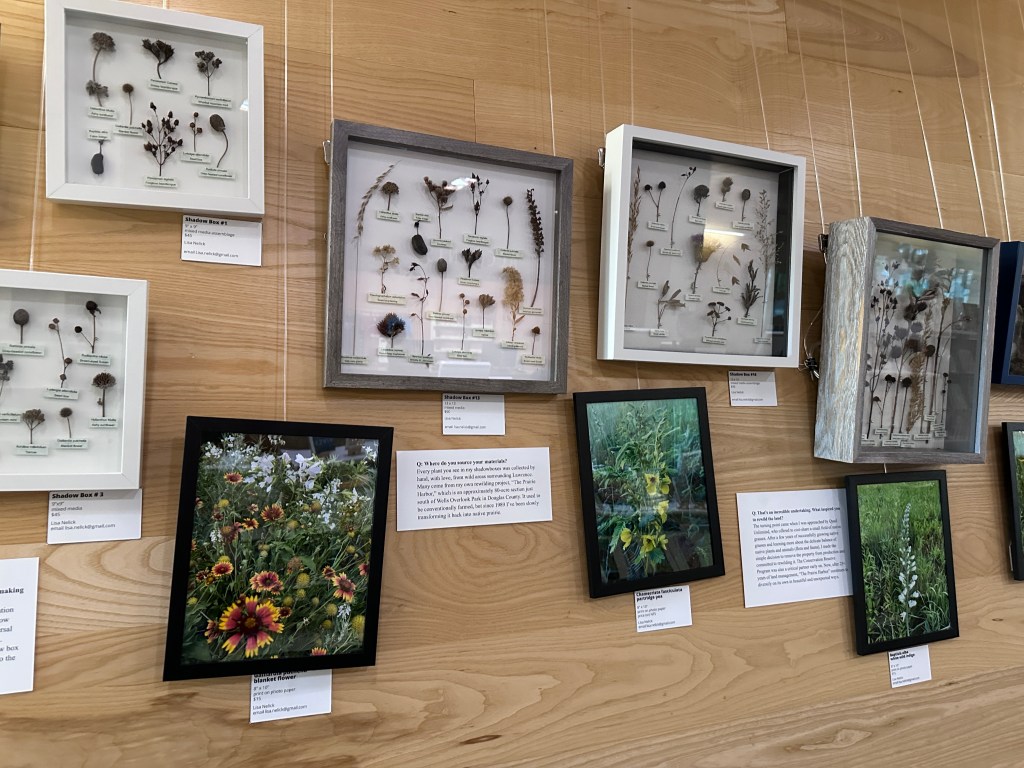
In anticipation of her Seedhead Shadowbox exhibit at Lawrence Public Library this month, we took a moment to speak with Lisa Nelick about her passion for native plants and how this project came about


Q: Lisa, can you tell us what inspired you to start making shadow boxes?
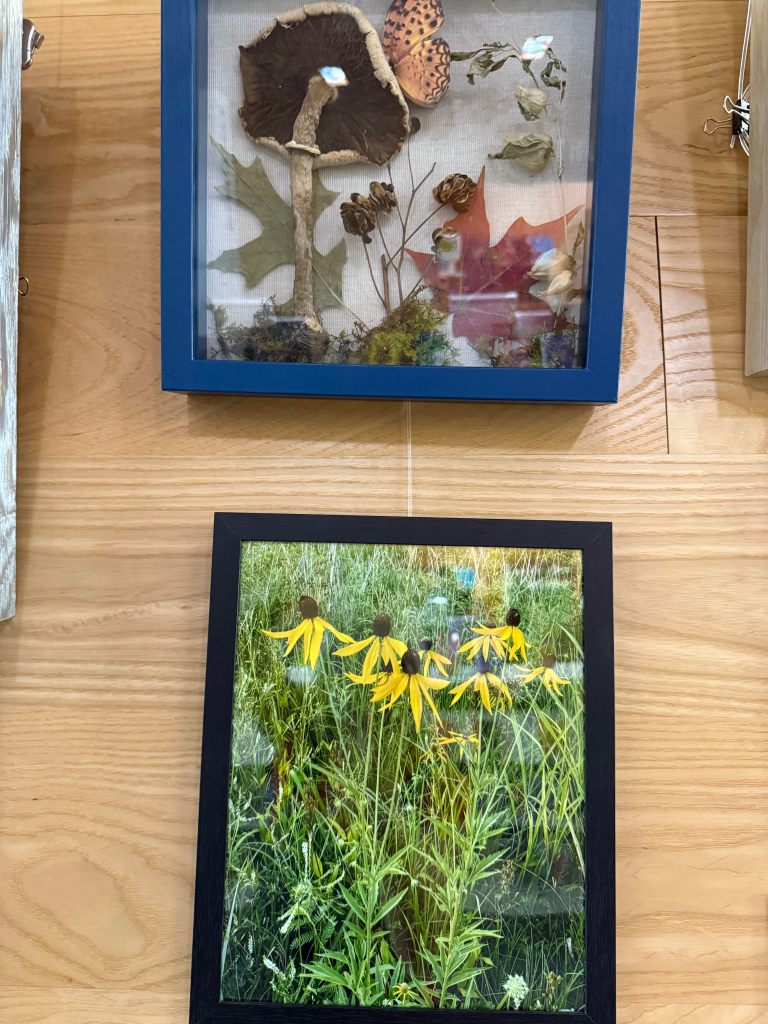
Absolutely. For me, the shadow boxes are about education and sharing the simple beauty of nature, specifically how Mother Nature has evolved these incredible seed dispersal mechanisms. I don’t consider this a formal art medium. Anyone with a love of prairie plants and a basic shadow box can do this. It’s a simple yet powerful way to connect to the native and naturalized plants that grow right around us.
Q: Where do you source your materials?
Every plant you see in my shadow boxes was collected by hand, with love, from wild areas surrounding Lawrence. Many come from my own rewilding project, “The Prairie Harbor,” which is an approximately 80-acre section just south of Wells Overlook Park in Douglas County. It used to be conventionally farmed, but since 1989 I’ve been slowly transforming it back into native prairie.

Q: That’s an incredible undertaking. What inspired you to rewild the land?
The turning point came when I was approached by Quail Unlimited, who offered to cost-share a small field of native grasses. After a few years of successfully growing native grasses and learning more about the delicate balance of native plants and animals (flora and fauna), I made the simple decision to remove the property from production and committed to rewilding it. The Conservation Reserve Program was also a critical partner early on. Now, after 25+ years of land management, “The Prairie Harbor” continues to diversify on its own in beautiful and unexpected ways.
Now, after 25+ years of land management, “The Prairie Harbor” continues to diversify on its own in beautiful and unexpected ways.
Q: Can you give an example of that natural transformation?
One of my favorite stories is that about 5 years after being planted in a simple “tall grassland mix” of about 7 species, mostly big grasses, one of the fields just sprang up with many thousands of flowering plants of native Penstemon digitalis (Foxglove Beardtongue). Not a single seed was planted by me. My only explanation was that these seeds were waiting 70+ years, sleeping in the soil, until they had the right conditions to grow again. What a miraculous sight this was!
Q: How did you learn so much about native plants and seed collecting?
Lawrence is a great place for learning about prairie diversity. You can easily find experts and other resources, especially those who are connected with KU’s biological survey programs and the easily available Parks and Rec, Lawrence Bird Alliance (formerly Audubon Society), and library adventures. I went on “Owl Howls” with Bill Busby; native plant walks with Kelly Kindscher, Courtney Masterson, Patti Ragsdale, Ken Lassman, and Frank Norman; and foraging cooking classes with Raven Naramore.
I went to local author book signings with Craig Freeman, Kelly Kindscher, and Sherry Kay. I bought and borrowed as many wildflower and weed books as I could find. Some of my best grassland ID books were actually written to help farmers identify “weeds” to eliminate from Cropland!
I visited my local Douglas County Extension office to talk with experts there. I found
answers to questions and started to build a true community of resources around my new curiosity about diversifying my grassland with forbs (wildflowers and non-grassy species that sustain a higher diversity). I also joined local groups like the Kaw Valley Herb Society, Monarch Watch, Lawrence Bird Alliance, and Friends of the Kaw to learn more about the plants themselves and how to acquire and plant them.
With several trips to local native plant growers like Vinland Valley Nursery, Botanical
Belonging, and The Flower Farm, and sales opportunities with organizations like The
Grassland Heritage Foundation, Lawrence Bird Alliance, and Monarch Watch, I started to build diversity by gathering some of the species my prairie lacked. With careful propagation and plant placement, the efforts paid off over the years.
Q: How did you get started with seed saving, and what have you learned from the
process?
Planting seeds can be the most economical way to diversify any ecosystem. Collecting my own seeds was the most economical way for me to plant. I took on the project of learning about seed saving.
It was easiest for me to learn most of the names of native plants when they were flowering. After all, many of the plants we call wildflowers evolved to catch attention (of either us or other species of animals and insects). I took photographs, pressed flowers, and gathered them for drying to help learn each species.
It wasn’t until I tried my hand at seed collecting with Courtney Masterson (Native Lands) and Patti Ragsdale (Botanical Belonging) that I learned what the seed-heads looked like when they are ripe and ready to pick for seeds. They can be much more subtle than the flower, and require a delicate balance in timing between the start of when the seeds are mature, and before all the seeds have been dispersed or eaten.
[Seed-heads] can be much more subtle than the flower, and require a delicate balance in timing between the start of when the seeds are mature, and before all the seeds have been dispersed or eaten.
Q: What led you to start creating educational seedhead shadow boxes?
It really started when I traded one of my custom terrariums for a shadow box made by
Rachael Kennmore at the 2023 Kaw Valley Seed Fair. I was so taken by its beauty and
usefulness that I started making my own. I found myself referencing it often, so I began
creating them for educational purposes. Over time, I started selling a few and even
incorporating fantasy elements, my little “prairie fairy” touches, to bring whimsy into the scientific mix.
Q: What would you say to someone who’s curious about making their own shadow box?
Give it a go and make your own! It doesn’t take much, just a love of nature and a respectful approach to collecting. Always forage responsibly: take only what you need, and only from places where it’s permitted. Shadow boxes are a lovely way to learn about the plants around you, especially in the fall when the prairie offers up its seeds.
Shadow boxes are a lovely way to learn about the plants around you, especially in the fall when the prairie offers up its seeds.
Q: Any last advice for budding native plant enthusiasts?
Start small. Visit the library’s seed catalog, borrow plant books, sign up for classes.
Download a plant ID app., join Facebook groups like the Kansas Native Plant Society and Native Habitat Managers. Most importantly, get outside and start observing. Nature gives freely when we take the time to notice. I hope I have inspired you to make a shadowbox of native species this fall, when the plants give freely of their bounty.
 Botanical Belonging